Snacking has a reputation problem it does not deserve. In nutrition coaching in Boston, Massachusetts, the number one habit sabotaging people’s calorie goals was not dinner. It was the unplanned 3 p.m. There is handful of chips, the mindless crackers in front of the TV, the oversized granola bar grabbed on the way out the door. Not because snacking is inherently bad, but because most people are choosing the wrong snacks in the wrong way. Calorie friendly snacks, ones that are genuinely satisfying, nutritionally complete, and appropriately portioned. They can actually reduce total daily calorie intake by preventing the ravenous hunger that drives overeating at main meals. This guide covers every category of calorie friendly snack. The biology behind why they keep you full, and the practical habits that make smart snacking work.
What Makes a Snack Calorie Friendly
Not every low-calorie snack is actually calorie friendly in the practical sense. Some 100-calorie packs leave hunger unchanged and cravings stronger. True calorie friendly snacks share specific nutritional properties that translate to genuine, lasting satiety rather than brief flavor satisfaction.
Understanding Calories and Snack Portions
A snack exists in a specific calorie range that distinguishes it from a meal and from a mindless mouthful:
- Calories as energy units: Each calorie represents a unit of chemical energy. Snack calories contribute to the daily total just as meal calories do. There is no metabolic distinction between a calorie eaten at lunch and one eaten at 3 p.m.
- Typical calorie friendly snack range (80-250 calories): below 80 calories, most snacks provide too little satiety to be worth eating. Above 250-300 calories, the snack begins to function as a small meal and should be planned accordingly. The 80-250 range is the practical zone for between-meal eating that contributes nutrition without meaningfully disrupting a calorie plan.
The Importance of Satiety in Snacks
The defining characteristic of a calorie friendly snack is not just low calories, it is a high satiety-per-calorie ratio. Three nutritional properties drive snack satiety:
- Protein increases fullness: protein produces the strongest hormonal satiety response of any macronutrient, stimulating PYY and GLP-1 (fullness hormones) and suppressing ghrelin (hunger hormone) more effectively than carbohydrates or fat at equivalent calorie levels. A 150-calorie Greek yogurt keeps hunger quiet for 2-3 hours; a 150-calorie handful of crackers does not.
- Fiber slows digestion: dietary fiber slows gastric emptying, extending the physical presence of food in the stomach, and is fermented by gut bacteria into short-chain fatty acids that directly signal the brain about fullness. High-fiber snacks produce more sustained satiety than low-fiber alternatives at the same calorie level.
- Water-rich foods increase volume: foods with high water content, most vegetables and fruits, provide physical stomach-filling weight at very low calorie cost. The stretch receptors in the stomach respond to volume and weight, not calorie count, triggering fullness signals independently of how many calories the food contained.
Why Snack Quality Matters More Than Snack Timing
The popular debate about whether to snack or not to snack misses the more important question: what kind of snack? The research on meal timing and snacking frequency does not support any specific optimal snacking schedule, what matters is whether the snack chosen provides nutrition and genuine satiety:
“Foods with lower energy density allow people to eat satisfying portions while managing calorie intake,” says Dr. Barbara Rolls, Professor of Nutrition at Penn State University and creator of the Volumetrics dietary framework. Her research on energy density and satiety consistently shows that high-volume, low-calorie-density foods, most vegetables and fruits, produce fullness comparable to higher-calorie-density alternatives, making them the core of effective calorie friendly snacking.
How Snacks Fit into a Balanced Daily Diet
Calorie friendly snacks are not extras added to a diet, they are strategic tools for managing hunger, maintaining energy, and preventing the overeating that happens when main meals are too far apart or too small.
Overeating at Main Meals
The most evidence-supported reason to include planned calorie friendly snacks is their ability to reduce total calorie intake at subsequent meals:
- Mid-afternoon hunger spikes: arriving at dinner genuinely starving, blood sugar low, ghrelin elevated, last meal six or more hours ago, predictably produces overconsumption. A 150-200 calorie calorie friendly snack at 3 p.m. reduces dinner calorie intake by approximately 200-300 calories in research studies, a net reduction in daily total intake.
- Evening cravings: strong late-evening food cravings are often driven by insufficient protein or fiber at earlier meals rather than genuine caloric need. A planned high-protein afternoon snack addresses this pattern directly, reducing the intensity of evening food-seeking behavior.
Supporting Energy Levels Throughout the Day
Strategic snacking supports cognitive performance and physical energy in ways that extend beyond simple hunger management:
- Blood sugar stability: the sharp blood glucose spike and subsequent crash that follows a high-glycemic meal produces fatigue, reduced concentration, and food cravings within 1-2 hours. A small, fiber-and-protein-containing snack between meals keeps blood glucose more stable, reducing energy volatility across the day.
- Mental focus: glucose is the brain’s primary fuel, approximately 120 grams per day under normal conditions. A small, well-timed snack during a long work session can meaningfully support concentration, particularly in the late afternoon window when blood sugar is naturally declining from the post-lunch period.
Who Benefits Most from Snacks
While calorie friendly snacks are broadly useful, specific groups find them particularly important:
- Active individuals: people who exercise regularly have higher daily energy needs and often benefit from a pre- or post-workout snack to fuel performance and support recovery. A 150-250 calorie snack with protein and carbohydrate 30-60 minutes after training supports muscle protein synthesis and glycogen replenishment.
- People eating smaller meals: individuals whose meal sizes are reduced for calorie management purposes have more opportunity for hunger to build between meals. Planned calorie friendly snacks bridge the gap without eliminating the calorie deficit.
- Those managing long workdays: people with 9-10+ hour workdays between lunch and dinner are particularly prone to the 3 p.m. energy crash and associated vending machine or delivery app decisions. A planned, accessible calorie friendly snack eliminates this high-risk decision point.
Table 1: Ideal Calorie Range for Different Snack Goals
Dietitians categorize snacks based on calorie targets that fit different goals and daily calorie budgets. These ranges help maintain overall calorie balance while addressing hunger between meals effectively.
| Snack Goal | Calories per Snack |
| Light snack (appetite suppression between meals) | 80–120 calories |
| Moderate snack (energy and mild hunger management) | 120–180 calories |
| Filling snack (replaces small meal, pre-workout) | 180–250 calories |
High Protein Calorie Friendly Snacks
Protein-based calorie friendly snacks are the most effective category for lasting fullness, because protein triggers the strongest and most sustained hormonal satiety response of any macronutrient. These options deliver meaningful protein within the 100-250 calorie snack range.
Greek Yogurt with Berries
Plain non-fat Greek yogurt is one of the most nutritionally complete calorie friendly snacks available:
- High protein: one cup of plain non-fat Greek yogurt provides 17-20 grams of protein at approximately 100 calories, an exceptional protein density that produces sustained fullness for 2-3 hours post-snack
- Whey and casein combination: Greek yogurt contains both fast-digesting whey protein and slow-digesting casein, producing both an immediate satiety signal and extended hunger suppression
- Naturally sweet with berries: adding half a cup of mixed berries adds fiber, antioxidants, and natural sweetness for approximately 40-50 additional calories, keeping the total snack at 140-160 calories with excellent nutritional completeness
Hard-Boiled Eggs
Hard-boiled eggs are the most portable, preparation-free high-protein calorie friendly snack available:
- Portable: pre-cooked hard-boiled eggs require no refrigeration for several hours and can be prepared in batches at the start of the week for 5-day convenience
- Nutrient dense: one large hard-boiled egg provides 6g protein and 5g fat at 70 calories, a complete, satisfying combination. Two eggs provide 12g protein and 140 calories, the upper end of the filling snack range, with fullness lasting 2-3 hours for most people
- Choline content: eggs are the highest dietary source of choline, a nutrient critical for brain function, liver health, and neurotransmitter synthesis that most Americans underconsume
Cottage Cheese with Fruit
Cottage cheese has one of the best protein-to-calorie ratios of any whole food, and it is frequently overlooked as a snack option:
- High protein to calorie ratio: half a cup of low-fat cottage cheese provides 12-14 grams of protein at approximately 90 calories, making it one of the most calorie-efficient protein snacks available
- High casein content: cottage cheese is primarily casein protein, the slow-digesting form that provides a sustained amino acid release. Research on casein’s appetite-suppressing effect shows it produces significantly longer satiety than equivalent amounts of whey protein.
- Pairs naturally with fruit: half a cup of cottage cheese topped with pineapple chunks, sliced strawberries, or peach slices creates a complete, satisfying snack at 130-160 calories with both protein and fiber
Protein Smoothies
When prepared with attention to ingredients, a protein smoothie can be one of the most nutritionally efficient calorie friendly snacks, or one of the highest-calorie mistakes:
- Base: one scoop of whey protein powder provides 20-25g protein at approximately 100-120 calories in most standard formulations. Common reputable brands include Optimum Nutrition Gold Standard Whey (24g protein, 120 cal per scoop) and Orgain Organic Protein (21g protein, 150 cal per serving, plant-based option).
- Build it right: one scoop protein powder blended with one cup unsweetened almond milk (30 calories) and half a frozen banana (50 calories) creates a genuinely satisfying 200-calorie snack with 22-25g protein. Adding two tablespoons of peanut butter, full-fat milk, and honey converts the same smoothie to 500+ calories.
High Volume Low Calorie Snacks
Volume-based calorie friendly snacks solve hunger through physical stomach filling rather than hormonal satiety signaling, delivering large portions that trigger stretch receptor fullness at very low calorie cost.
Air-Popped Popcorn
Air-popped popcorn is perhaps the highest-volume calorie friendly snack available, three cups at only 90 calories:
- High volume per calorie: popcorn is approximately 96% air by volume. Each cup weighs about 8 grams and contains only 30 calories. Three cups delivers real, extended eating satisfaction, physical chewing time and stomach filling, for the calorie cost of two Oreo cookies.
- Fiber content: three cups of air-popped popcorn provides approximately 3.5 grams of fiber, supporting both satiety and gut health at negligible calorie cost
- Flavor without calories: seasoning air-popped popcorn with nutritional yeast (cheesy flavor, 2g protein per tablespoon, 20 calories), cinnamon and stevia, or smoked paprika and garlic powder adds significant flavor interest at near-zero calorie addition
Raw Vegetables with Light Dip
Raw vegetables are the ultimate high-volume, low-calorie snack category, providing physical bulk with minimal calorie contribution:
- Carrots: 52 calories per cup chopped; natural sweetness satisfies mild sugar cravings; dense crunch requires sustained chewing that extends the eating experience
- Cucumbers: 16 calories per cup sliced; 96% water by weight; refreshing, neutral flavor
- Bell peppers: 30-40 calories per cup sliced depending on color; red bell peppers contain more vitamin C per gram than oranges; natural sweetness
Light dip additions, two tablespoons of hummus (70 calories), plain Greek yogurt dip (25 calories per two tablespoons), or guacamole (50 calories), add healthy fat or protein to the vegetables without pushing the snack above the 150-180 calorie range.
Fresh Fruit Bowls
Fresh fruit snacks deliver natural sweetness, fiber, and hydration, addressing the sugar cravings that hit many people in the mid-afternoon while keeping calories in the friendly range:
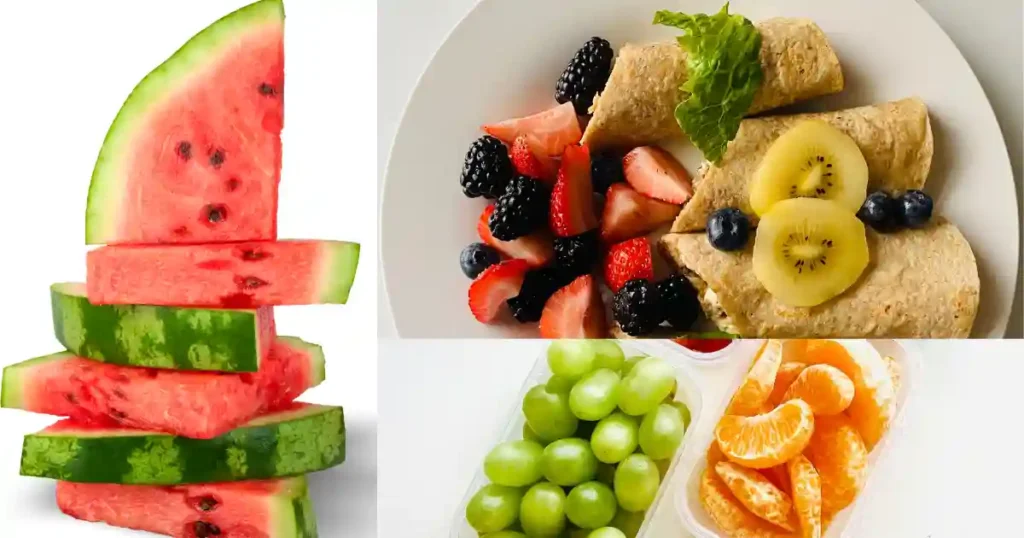
- Strawberries: 49 calories per cup; 91% water; high vitamin C; naturally sweet enough to satisfy dessert-adjacent cravings
- Watermelon: 46 calories per cup cubed; 92% water by weight; among the lowest calorie density of any fruit. It provides lycopene, an antioxidant associated with cardiovascular health
- Pineapple: 83 calories per cup chunks; high manganese and bromelain (a proteolytic enzyme with anti-inflammatory properties); natural sweetness at low energy density
Table 2: High Volume Snacks With Low Calories
Nutrition experts recommend high water and fiber content snacks specifically because they control appetite through physical volume rather than requiring calorie counting at every snack. These quantities fill the hand, fill the stomach, and barely impact the daily calorie total.
| Snack | Portion | Calories |
| Air-popped popcorn | 3 cups (~24g) | ~90 calories |
| Strawberries | 1 cup (~152g) | ~49 calories |
| Carrot sticks | 1 cup chopped (~128g) | ~52 calories |
| Cucumber slices | 1 cup sliced (~119g) | ~16 calories |
| Cherry tomatoes | 1 cup (~149g) | ~27 calories |
| Watermelon (cubed) | 1 cup (~152g) | ~46 calories |
Quick Calorie Friendly Snacks for Busy Days
The best calorie friendly snack is ultimately the one that is accessible when hunger strikes. For busy days, these options require minimal preparation and deliver both convenience and genuine satiety.
Apple with Peanut Butter
Apple with one tablespoon of natural peanut butter is a nutritionally balanced calorie friendly snack that addresses multiple satiety mechanisms simultaneously:
- Balanced carbohydrates and fat: the apple provides 95 calories of fiber-rich complex carbohydrate that digests slowly; one tablespoon of peanut butter adds 95 calories of healthy fat and protein (4g) that extends satiety beyond what fruit alone provides
- Fiber combination: four grams of fiber from the apple slows glucose absorption; the fat from peanut butter further slows gastric emptying. Total snack: approximately 190 calories, 2-3 hours of satiety.
- Portion awareness: the most common mistake with peanut butter is free-pouring. One measured tablespoon is 95 calories; two tablespoons is 190 calories; three tablespoons, common in unmonitored portions, is 285 calories just from the peanut butter. Measuring makes this snack genuinely calorie friendly.
String Cheese
String cheese is one of the most convenient, genuinely portable high-protein calorie friendly snacks:
- Convenient protein: one stick of part-skim mozzarella string cheese provides 6-7 grams of protein and approximately 80 calories, quick, shelf-stable for several hours, and requires no preparation
- Portion control built in: the individual-serving format is the primary advantage, unlike a block of cheese that requires measuring, string cheese is naturally pre-portioned at a snack-appropriate calorie level
Rice Cakes with Avocado
Two plain rice cakes with a quarter of a medium avocado create a genuinely satisfying calorie friendly snack in the 120-140 calorie range:
- Light calorie base: two plain rice cakes provide approximately 70 calories with a satisfying crunch that addresses the texture craving that many people experience when hungry
- Healthy fat from avocado: a quarter avocado (approximately 60 calories) provides monounsaturated fat that triggers cholecystokinin release, a satiety hormone that signals fullness through the vagus nerve, extending the satisfied feeling beyond what the low-calorie base alone would produce
Nuts in Controlled Portions
Nuts are among the most nutrient-dense calorie friendly snack options, but also among the easiest to accidentally overconsume:
- Healthy fats and protein: almonds, walnuts, cashews, and pistachios all provide a combination of monounsaturated fat, protein, and fiber that produces strong satiety signals. One ounce of almonds provides 6g protein, 3.5g fiber, and 14g healthy fat at 164 calories.
- Portion precision is essential: the calorie density of nuts (160-200 calories per ounce) means that casual eating from a large container consistently produces 2-4x intended portions. Pre-portioning nuts into 1-oz servings in small containers or bags at the start of the week is the most reliable way to keep nuts as a calorie friendly snack rather than a calorie bomb.
Real-Life Snack Example From a Typical Workday
Wednesday afternoon in Chicago, Illinois. Cold wind against the windows, coffee shops packed, most people fighting the 3:30 p.m. concentration dip that reliably arrives no matter how good the morning was.
Hunger is unmistakable. The afternoon meeting is done. Dinner is still two and a half hours away. The decision point: vending machine in the hallway (a 250-calorie bag of pretzels that will produce hunger again in 45 minutes) or the planned snack from the bag at the desk.
The planned snack: three-quarter cup of plain Greek yogurt with a handful of blueberries and ten almonds. Total: approximately 200 calories, 18g protein, 4g fiber, 9g healthy fat. The protein and fat combination means hunger stays quiet for two and a half hours, right through to dinner.
This is what calorie friendly snacks do in practice. They are not about deprivation or willpower. They are about making the planned, satisfying option available at the moment hunger strikes, so the impulsive high-calorie decision never has to happen.
Expert Advice From a U.S. Registered Dietitian
The clinical consensus on calorie friendly snacks consistently emphasizes planned choices over impulsive ones, nutrition over restriction, and food quality over marketed ‘diet’ products.
“Smart snacking isn’t about avoiding food between meals. It’s about choosing foods that add nutrition rather than empty calories,” says Keri Gans, MS, RDN, registered dietitian nutritionist and author of The Small Change Diet. “The clients who struggle most with snacking are usually eating foods that are technically low in calories but provide no protein or fiber, so they’re hungry again 30 minutes later and eat more. The ones who succeed are choosing snacks with protein, fiber, or both. Hunger doesn’t persist when those two things are present.”
Why Planned Snacks Work Better
The behavioral nutrition evidence for planned versus impulsive snacking is clear:
- Reduces impulsive eating: when a specific snack is already planned and accessible, the decision about what to eat at 3 p.m. is already made. Decision fatigue and hunger no longer operate, the choice is simply eating what was prepared.
- Maintains stable energy: a planned snack at a consistent time stabilizes the blood sugar pattern of the afternoon, preventing the sharp decline that drives impulsive high-calorie choices. People who eat planned calorie friendly snacks consistently consume fewer total daily calories than those who snack impulsively.
Why Portion Awareness Matters
Even the most nutritious calorie friendly snacks can exceed their calorie range if portion sizes are not managed:
- Nuts triple in calories if poured freely: from 164 to 500+ calories from one serving to three
- Peanut butter doubles or triples with generous spreading: from 95 calories to 285-380 per serving
- Granola, often perceived as a health food, can add 400 calories to a yogurt bowl. When poured without measuring, compared to 120 calories for the standard quarter-cup serving
Measuring calorie-dense snack additions for a few weeks builds visual calibration that persists for months afterward, the most practical long-term investment in keeping calorie friendly snacks actually calorie friendly.
Healthy Store-Bought Calorie Friendly Snacks
Homemade snacks are ideal, but not always realistic. These store-bought options are genuinely calorie friendly when selected and portioned correctly.
Protein Bars
Protein bars vary dramatically in calorie and nutritional content, from genuinely effective calorie friendly snacks to candy bars with protein powder added:
- RXBAR: made from egg whites, nuts, and dates with no added sugars, artificial flavors, or fillers; 200-220 calories per bar with 12g protein. A genuinely whole-food protein bar that functions as a filling snack.
- Quest Nutrition bars: higher protein (20-21g per bar) at 180-200 calories; high fiber content (13-14g) from soluble corn fiber; useful for people needing a protein-forward snack. Flavor range is extensive, check that the specific flavor chosen is not heavily sweetened with non-fiber carbohydrates.
- What to check on any protein bar label: calories per bar (not per serving, some have 1.5 servings per bar), protein grams (minimum 10g for a meaningful snack), fiber grams, and added sugar grams (under 5g preferred)
Pre-Packaged Yogurt Cups
Pre-packaged yogurt cups provide built-in portion control, a significant advantage for calorie management:
- Single servings remove the need to measure: a 5.3 oz container of Greek yogurt has a fixed calorie content, typically 80-120 calories for plain non-fat varieties, regardless of how hungry the person eating it is
- Quality variation matters: plain non-fat Greek yogurt cups are genuinely calorie friendly; flavored yogurt cups often contain 15-25g of added sugar per serving, more than tripling the sugar content and pushing total calories to 150-200+ for what might appear to be a ‘light’ option
Roasted Chickpea Snacks
Roasted chickpeas are among the most nutritionally complete packaged calorie friendly snacks available:
- Crunchy and high fiber: one ounce of roasted chickpeas provides approximately 5g fiber and 6g protein at 120 calories, addressing both the texture craving (crispy, satisfying crunch) and the nutritional requirements of a genuine calorie friendly snack
- Plant protein advantage: chickpea snacks provide a plant-based protein and fiber combination in a portable, shelf-stable format, useful for people who want calorie friendly snacks without dairy or meat
Table 3: Convenient Low-Calorie Packaged Snacks
Dietitians recommend packaged snacks with simple ingredients and moderate calorie counts. This expanded table includes a ‘watch out for’ column because the same snack category can range from genuinely calorie friendly to problematic depending on specific product selection.
| Packaged Snack | Typical Calories | Key Benefit | Watch Out For |
| Greek yogurt cup (plain) | ~100 cal | High protein (15-17g) | Flavored versions: added sugar |
| Rice cakes (plain) | ~35 cal each | Very low calorie density | Flavored versions: sodium/sugar |
| Roasted chickpeas | ~120 cal per oz | Fiber + plant protein | Check oil and salt content |
| Light popcorn bags (microwave) | ~100 cal per bag | High volume, low density | Some contain butter flavorings |
| String cheese | ~80 cal per stick | Portable, 6-7g protein | Sodium content |
Homemade Calorie Friendly Snack Ideas
Homemade calorie friendly snacks give complete control over ingredients, portions, and nutritional composition, producing better outcomes than most store-bought alternatives at lower cost.
Veggie Snack Boxes
A veggie snack box, prepared at the start of the week and ready in the refrigerator, is one of the most effective calorie friendly snack strategies available:
- Contents: sliced cucumbers, cherry tomatoes, carrot sticks, bell pepper strips, and two tablespoons of hummus on the side. Total: approximately 130-150 calories for a genuinely filling, high-volume snack box.
- Preparation: five minutes on Sunday produces a week’s worth of pre-assembled snack boxes. Visual accessibility matters, a snack box at eye level in the refrigerator is chosen more often than one requiring assembly.
- Why it works: the combination of very low calorie density vegetables with protein-and-fat-containing hummus addresses all three satiety mechanisms, physical volume, protein, and fat, in a single 130-calorie serving
Yogurt Parfaits
A layered yogurt parfait is one of the most satisfying calorie friendly snacks when portions are measured:
- Base: three-quarter cup of plain non-fat Greek yogurt, approximately 17g protein at 100 calories
- Topping: half a cup of mixed berries for fiber, antioxidants, and natural sweetness, approximately 40 calories
- Crunch: one to two tablespoons of granola, approximately 60-120 calories depending on variety. This is the critical measurement; free-pouring granola is the most common way yogurt parfaits become 400+ calorie snacks instead of 200-calorie ones.
- Total carefully portioned: approximately 200-260 calories with 18-20g protein, the ideal filling calorie friendly snack
Frozen Fruit Pops
Homemade frozen fruit pops are one of the most effective calorie friendly snacks for addressing dessert-type cravings:
- Basic formula: blend one cup of mixed frozen fruit (mango, strawberry, or mixed berry) with three-quarter cup of plain Greek yogurt and pour into popsicle molds. Freeze for four hours. Each pop (from a standard 6-mold set) contains approximately 50-70 calories with 5-6g protein.
- Why they work for calorie management: the frozen format slows eating pace dramatically compared to liquid or room-temperature snacks, extending the eating experience and providing physical satisfaction comparable to commercial ice cream at 15-25% of the calories
Common Snacking Mistakes to Avoid
Even thoughtfully chosen calorie friendly snacks are undermined by specific habit patterns that are extremely common and entirely preventable.
Mindless Snacking While Watching TV
Distracted eating is the primary mechanism of unintentional overconsumption from snacking:
- Loss of portion awareness: people who eat while watching television consume 15-25% more calories per eating occasion than those eating without screen distraction, consistent finding across multiple research studies on eating attention
- The solution is not avoiding TV, it is pre-portioning the snack before sitting down, putting the bag or container away, and eating from a bowl or plate. The physical act of getting up for more food creates a natural decision point that mindless reaching from a bag does not.
Drinking Calories Instead of Eating Them
Liquid calories undermine calorie friendly snacking habits in two ways:
- Sugary beverages and sweet coffee drinks do not register as snacks: a 16-oz flavored latte with whole milk is 250-350 calories, more than a substantial filling snack, but is perceived as a beverage rather than food, so subsequent meal and snack intake is not reduced to compensate.
- Liquid calories produce minimal satiety: research consistently shows that liquid calories do not produce the same satiety hormone response as equivalent solid calories. Drinking 200 calories of juice produces less fullness than eating 200 calories of fruit, despite identical caloric content.
Choosing Highly Processed Diet Snacks
Many products marketed as diet snacks or healthy snacks are nutritionally counterproductive for calorie friendly eating:
- Many contain hidden sugars: 100-calorie snack packs, diet cookies, and ‘light’ granola bars often achieve low calorie counts by reducing serving size rather than improving nutrition, providing 100 calories of refined carbohydrate and sugar that produce minimal satiety and strong subsequent cravings
- Artificial sweeteners and cravings: highly sweetened diet products may reinforce sweet taste preferences and perpetuate cravings for high-calorie sweet foods, the opposite of what calorie friendly snacking aims to achieve
Grocery Shopping Tips for Healthy Snacks
The calorie friendly snacks that are available at home determine default snacking choices, making grocery habits the upstream determinant of snacking success.
Prioritize Whole Foods
Whole foods, fruits, vegetables, dairy, eggs, nuts, form the foundation of effective calorie friendly snacking:
- Fruits and vegetables: buy pre-washed salad greens, baby carrots, cherry tomatoes, and sliced bell peppers in ready-to-eat formats, accessibility reduces preparation friction and increases likelihood of choosing these over packaged alternatives
- Dairy: Greek yogurt, cottage cheese, and string cheese provide high protein in convenient formats, buy plain varieties and add fruit or seasoning at home rather than buying pre-flavored versions with added sugar
Keep Portable Snacks Available
The best calorie friendly snack is the one available when hunger strikes:
- Nuts in pre-portioned bags: measure 1-oz portions into small bags or containers at the start of the week, eliminates the portion control failure that makes nuts a calorie problem instead of a calorie friendly choice
- Protein bars: keep a few genuinely nutritious bars (RXBAR, Quest) in the bag or desk drawer, not for daily use, but as the insurance against the vending machine moment
- Yogurt: individual Greek yogurt cups in the refrigerator take 30 seconds to eat and require zero preparation, the minimum-friction high-protein snack option
Read Nutrition Labels Carefully
Nutrition label literacy is the difference between genuinely calorie friendly snacks and foods that appear healthy while containing significant hidden calories:
- Check serving size first: the most common source of snack calorie underestimation, consuming multiple servings while counting one. Many packaged snacks list 2-3 servings per container.
- Watch calorie counts and added sugars: aim for calorie friendly snacks under 200 calories per serving and under 5g added sugar for savory options; for sweeter snacks, natural sugars from fruit are acceptable while added sugars should be minimized
Who Benefits Most From Calorie Friendly Snacks
Calorie friendly snacks provide meaningful value for virtually any adult managing their eating, but specific groups find them especially impactful.
People Trying to Lose Weight
For anyone in a calorie deficit, unplanned snacking is one of the most reliable ways to inadvertently eliminate the deficit. Replacing impulsive snacking with planned calorie friendly snacks maintains the daily deficit while preventing the severe hunger that triggers overeating at subsequent meals. Research consistently shows that people who include protein and fiber-rich snacks in a calorie-controlled diet maintain higher adherence rates than those who attempt to snack only on ‘diet foods’ or avoid snacking entirely.
Individuals Managing Hunger Between Meals
People with strong or frequent hunger signals between meals, whether from high activity levels, smaller meal sizes, or natural appetite variation, benefit most directly from planned, high-satiety calorie friendly snacks. The protein-and-fiber combination that characterizes the best calorie friendly snacks addresses hunger physiologically rather than relying on willpower.
Active People Needing Small Energy Boosts
Athletes and active individuals have elevated calorie needs and often require strategic between-meal eating to support performance and recovery. A 150-200 calorie snack containing protein and carbohydrate 30-60 minutes before training improves workout quality; the same type of snack 30-60 minutes after training supports muscle protein synthesis and glycogen replenishment.
Final Thoughts on Choosing Calorie Friendly Snacks
Snacking does not derail healthy eating goals, the wrong snacks do. Calorie friendly snacks, chosen with intention and eaten with awareness, support fat loss, energy stability, and nutritional completeness simultaneously.
The pattern that consistently works: high-protein, high-fiber snacks, Greek yogurt, hard-boiled eggs, cottage cheese, raw vegetables with hummus, eaten at planned times from pre-portioned portions. High-volume, low-calorie options, air-popped popcorn, fresh fruit bowls, raw vegetables, for when physical volume and eating satisfaction matter most.
Keep calorie friendly snacks accessible, portion calorie-dense additions carefully, and plan the snack before hunger makes the decision, not after.
Final Recommendation
After years of coaching clients on snacking habits and testing these approaches personally, here is the practical guidance for making calorie friendly snacks work consistently:
Plan two snacks into your daily eating structure. Identify specific times, typically mid-morning if breakfast is small and mid-afternoon before the 3-5 p.m. energy dip, and decide what the snack will be before the day starts. Planned snacks eliminate the impulsive decision-making that produces high-calorie choices.
Always include protein or fiber, ideally both. A snack without either will not produce meaningful satiety. Greek yogurt, cottage cheese, hard-boiled eggs, hummus with vegetables, or a small handful of nuts with fruit, all check the protein-plus-fiber requirement that makes calorie friendly snacks genuinely satisfying.
Pre-portion calorie-dense snack foods. Measure nuts, peanut butter, granola, and cheese before eating, never eat these directly from a large container. Two minutes of Sunday prep (portioning snack bags for the week) saves the 300-500 daily calorie errors that unportioned calorie-dense snacks routinely produce.
Keep vegetables and fruit washed and accessible. The snack chosen is almost always the one that requires the least preparation. Pre-washed baby carrots, cherry tomatoes, cut fruit, and ready-to-eat Greek yogurt cups at eye level in the refrigerator make the calorie friendly choice the automatic choice.
Drink water before reaching for a snack. Mild dehydration produces hunger-like signals. One full glass of water, waited 10 minutes, resolves a meaningful percentage of between-meal hunger, reducing the calorie cost of the afternoon entirely on some days.
Snack Smarter: Calorie Friendly Snacks That Actually Keep You Full Longer
You do not have to go hungry between meals. Here is how to find calorie friendly snacks that actually keep you full longer and taste great too.
Look for snacks with lots of fiber and protein. These two things slow down your digestion. This helps you feel very full on just a little bit of food.
Greek yogurt and hard eggs are top picks. They are easy to carry and full of protein. They give you steady energy without a crash later on.
Yes, apples and berries are great choices. They have water and fiber to fill your belly. This is a sweet way to stay on track with your daily goals.
Chips and crackers lack the protein needed to satisfy your brain. You eat more because your body is still looking for fuel. Stick to nuts or seeds instead.
Try to portion your snacks into small bowls first. This helps you see exactly how much you are eating. It is a smart way to keep your calories in check.

Dr. Selim Yusuf is a professional physician and metabolic health expert dedicated to helping individuals achieve long-term weight stability. With years of clinical experience, Dr. Yusuf specializes in the science of caloric maintenance, the critical “missing link” between short-term dieting and lifelong health.
While many health platforms focus solely on weight loss, Dr. Yusuf recognizes that the greatest challenge lies in maintaining results. His medical approach moves beyond simple math, accounting for hormonal balance, metabolic adaptation, and lifestyle factors. Through Maintenancecaloriecalculator.us, he provides a precision-engineered tool designed to help users find their “metabolic zero”, the exact caloric intake needed to fuel the body without unwanted weight fluctuations.